Getting to Know You Activities for Teachers
Hindered past video screens, fluctuating schedules, and health regulations, teachers are upward against the odds this school year when it comes to getting to know their students.
"It's hard to actually get to know your students through a webcam," @mark_bevacqua wrote on Twitter, while @cheri_cheralex shared her struggles of seeing students in masks or "with optics only."
While become-to-know-you activities are typically earmarked for the first weeks of school, they shouldn't terminate there, say educators and researchers.
Whether it'due south that they love to play baseball, take three brothers, or enjoy writing or photography, jubilant your students' unique experiences and identities tin can bolster connections that keep them engaged and performing better in school. Students who have a deeper sense of self—and purpose—are besides improve able to ascertain their goals and stay focused on pursuing them, concluded a 2014 written report from David Yeager, Angela Duckworth, and colleagues.
Nosotros collected an array of class exercises from interviews with teachers, online resources, and our archives that will help students develop greater self-awareness and purpose. These insights can also give you a amend sense of who they are, so yous can exist responsive to their interests—even if you're separated past screens or masks.
Reflecting on Experiences: 'Laws of Life' Essays
In the early 2000s, educators in an urban, high-poverty district in New Jersey gave their center and high school students an interesting essay assignment: Write nearly the values and principles that guide your life.
The seemingly small activeness, called "Laws of Life," is based on the piece of work of philanthropist John Templeton, and it turned into a much bigger project that helped students develop a stronger sense of cocky, purpose, and possibility for the futurity, according to Maurice Elias, a psychology professor at Rutgers University. The projection has since been replicated all over the world.
To run the assignment in your grade, Elias recommends asking students to reflect on their by—in and out of schoolhouse—and the experiences and people that made them who they are. From at that place, take students discern cardinal characteristics that have influenced their lives and and so craft an essay—or create a video or other multimedia content—focused on the "laws" or principles that drive them.
Question prompts like "Who exercise you admire? Listing three of their beauteous traits" and "Describe an incident or event from which you learned a lesson 'the hard way'" can help guide students. Periodically throughout the year, have students refer back to their essays to reverberate on what they wrote and ask themselves, "What'due south changed?" and "What's stayed the aforementioned?"
Exploring Identity—and Perceptions About It: Identity Charts
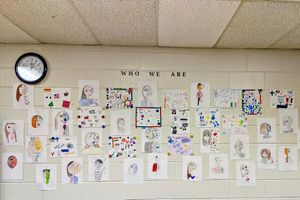
To get to know her students and ensure that they felt seen in her classroom, middle school teacher Shana White created a lesson to aid them explore their identities. First, White gear up a foundation for discussion by defining identity and explaining how identities can sometimes exist visible, like age, or invisible, like a person's life experiences.
Then, with the permission of six of her friends, White shared photos of their faces and had students approximate their "identity characteristics." Afterward, she revealed the truthful details and led a class give-and-take about making assumptions about others based on how they wait or deed. To finish the project, students drew their own "identity portraits" or a pic of their face with half the face showing visible characteristics and the other half showing invisible characteristics.
Courtesy of Shana White
Students' identity portraits hang on a wall in Shana White's classroom.
The education organization Facing History and Ourselves recommends a similar exercise called the "Who am I?" activity for middle school students. To get-go, select some fundamental historical figures or fictional characters—retrieve inclusively and avoid stereotypes, selecting a wide range of people from different backgrounds—and ask students to hash out "factors such as religion, gender, and geography" that influenced their identities.
Next, take students read the chapter "My Name" from the volume The House on Mango Street, where the main graphic symbol, Esperanza, talks about her proper name, revealing details about her culture. Ask students to create an identity chart for Esperanza, answering questions such as "What is her family like?" and "What does her name reveal about her personality?" Guided by the reading, students can so create identity charts for themselves and share them with the form.
Learning Important Details: Pupil Inventories
Student inventories can help teachers speedily discern details and facts about students that shape who they are, and can exist used to plan further class activities and lessons. Ask students to listing their favorite musicians, songs, sports, activities, games, or food, for instance, or probe deeper with questions about their culture, memories, and family.
Another option is having students write 20 sentences that consummate the prompt, "I am someone who…" or asking a short list of idea-provoking questions in one-to-one Hopes and Dreams conferences. Target questions that tap into who students are at present and who they hope to be, such as "What are some things that issues you about the world?" "What inspires you?" and "What dreams do you take after high schoolhouse?"
Look for patterns in student responses, and use what you learn to make classroom lessons and activities connected to students' interests, advises Rebecca Alber, an education professor in California, who says, "Students need to see connections between learning and their lived experiences."
Understanding Interests: Passion Blogging
In Allison Berryhill's high schoolhouse English form, literary analysis exercises left her students "frozen," and free-writing assignments produced hard-to-read rants. Influenced by the volume Beyond Literary Assay, Berryhill started offering a new practice called "passion blogging" last yr, in which students write about topics that interest them.
Courtesy of Allison Berryhill
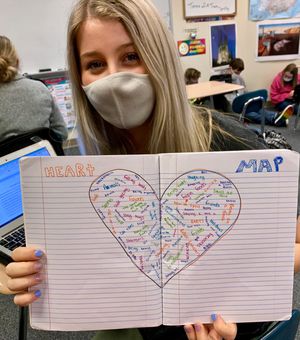
A student in Allison Berryhill'due south form holds up her heart map.
Students commencement by drawing "middle maps," or big hearts filled with illustrations and words that represent their passions. Then, they select 1 or two topics to explore further and await for related articles, images, and videos. Berryhill also gives accompanying class lessons on attribution of sources, texts, quotes, and imagery, and shares mentor texts to guide students' writing.
Students' blogs have run the gamut in subject matter, from pheasant hunting to hunger strikes to hiking, and give them an opportunity to dive securely into things they care about. As function of the procedure, students are too tasked with reading and evaluating several of their classmates' blogs. Overall, the low-stakes activeness has served as a springboard to build students' literary assay skills for harder assignments, says Berryhill, while helping her get to know them improve.
Documenting Your Life: Movies, Photos, and Podcasts
Though many teachers and students are feeling virtual encephalon drain, digital tools can provide new, creative outlets for students to share and define their interests and personalities. Teachers are having students create autobiographical mini-movies or trailers almost their lives and produce podcasts or write articles for digital school newspapers on problems they intendance about.
Influenced by her customs's experiences during the pandemic, Wendy McElfish, a high school instructor in California, taught a lesson on Dorothea Lange's famous black-and-white photography from the Peachy Depression. Then, she had her students accept their own photos with phones to document their lives. She guided them with the themes "life exterior your door," "through a window," "different life inside," and "porch photos of your family."
video
"When kids are faced with terrible circumstances, sometimes information technology helps to take an artistic approach," she said. "A lot of kids aren't adept writers, but they have an eye and they accept a phonation... [and] they tin can show the globe what I come across."
Similarly, Lori Wenzinger, a middle schoolhouse social studies teacher in South Carolina, paired upwards with a local photographer to create a iii-calendar week multimedia project called "Finding Your Joy." After the lensman taught two classes on photo composition and mood, students were tasked with taking photos that "capture joyful moments throughout their day," sharing and reviewing them as a class, and selecting their three favorites to keep in the class Google Drive.
Having Fun: Icebreakers, Games, and Accolades
Courtesy of Cathleen Beachboard
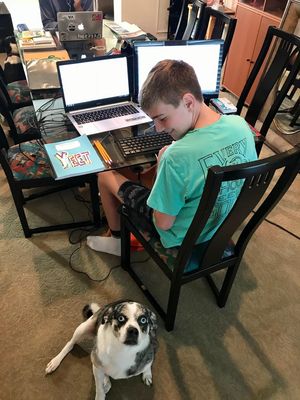
A educatee in Cathleen Beachboard's grade brings his dog to form for show-and-tell during remote learning.
In addition to more comprehensive assignments and lessons, teachers can build in brusk, entertaining activities that keep students engaged and reveal insights almost who they are.
Trevor Boffone, a high school teacher in Texas, asked his students to submit their favorite song to a list at the starting time of the year. Now, at the starting time of each virtual class, he plays music to boot things off, incorporating students' picks and his ain.
Throughout remote learning, Cathleen Beachboard, a center school teacher in Virginia, says she'southward including fun activities similar show-and-tells and theme days. This fall, she also adopted a do that her superintendent uses for staff meetings called "Iii Cool Things I've Seen." In one case a week, Beachboard calls out iii things she's observed about students from classes that week that recognize them for their individuality.
"I know a lot of teachers are struggling correct now getting students pulled in. I found the more than encouragement and authentic praise we give to students, the more they dive in," she said. "These are scary times, but by giving students time to showcase their individuality, they volition experience prophylactic and ready to fully engage in learning."
Source: https://www.edutopia.org/article/6-exercises-get-know-your-students-better-and-increase-their-engagement
0 Response to "Getting to Know You Activities for Teachers"
Post a Comment