Do You Need to Know Algebra to Take Plane Geometry

Aeroplane equation in normal grade
In mathematics, a plane is a flat, ii-dimensional surface that extends indefinitely.[1] A aeroplane is the two-dimensional analogue of a bespeak (nix dimensions), a line (1 dimension) and three-dimensional infinite. Planes tin ascend equally subspaces of some higher-dimensional space, as with one of a room's walls, infinitely extended, or they may savor an independent existence in their ain right, every bit in the setting of two-dimensional[2] Euclidean geometry.
When working exclusively in two-dimensional Euclidean space, the definite article is used, so the plane refers to the whole infinite. Many fundamental tasks in mathematics, geometry, trigonometry, graph theory, and graphing are performed in a two-dimensional space, often in the aeroplane.
Euclidean geometry [edit]
Euclid set forth the first dandy landmark of mathematical thought, an axiomatic treatment of geometry.[three] He selected a small cadre of undefined terms (called common notions) and postulates (or axioms) which he then used to prove various geometrical statements. Although the plane in its modern sense is not directly given a definition anywhere in the Elements, it may exist thought of as role of the common notions.[4] Euclid never used numbers to measure length, bending, or expanse. Although the Euclidean plane is not quite the same as the Cartesian plane, they are formally equivalent.

A plane is a ruled surface
Representation [edit]
This section is solely concerned with planes embedded in three dimensions: specifically, in R 3.
Determination by independent points and lines [edit]
In a Euclidean space of any number of dimensions, a plane is uniquely determined by any of the following:
- Three non-collinear points (points not on a single line).
- A line and a bespeak non on that line.
- Two distinct merely intersecting lines.
- Two distinct but parallel lines.
Backdrop [edit]
The following statements hold in three-dimensional Euclidean space just not in higher dimensions, though they have college-dimensional analogues:
- Two distinct planes are either parallel or they intersect in a line.
- A line is either parallel to a plane, intersects it at a single indicate, or is contained in the airplane.
- Two distinct lines perpendicular to the same plane must be parallel to each other.
- Ii distinct planes perpendicular to the same line must be parallel to each other.
Point–normal form and full general class of the equation of a airplane [edit]
In a manner analogous to the way lines in a ii-dimensional space are described using a point-slope form for their equations, planes in a three dimensional space have a natural description using a point in the plane and a vector orthogonal to it (the normal vector) to signal its "inclination".
Specifically, let r 0 exist the position vector of some betoken P 0 = (ten 0, y 0, z 0), and let north = (a, b, c) be a nonzero vector. The plane determined by the point P 0 and the vector n consists of those points P , with position vector r , such that the vector fatigued from P 0 to P is perpendicular to n . Recalling that two vectors are perpendicular if and but if their dot product is naught, it follows that the desired airplane can be described as the gear up of all points r such that

The dot hither means a dot (scalar) product.
Expanded this becomes

which is the point–normal form of the equation of a aeroplane.[five] This is just a linear equation

where
- ,

which is the expanded form of

In mathematics information technology is a common convention to limited the normal as a unit vector, only the above argument holds for a normal vector of any non-zilch length.
Conversely, it is easily shown that if a, b, c and d are constants and a, b , and c are not all zero, and so the graph of the equation
is a airplane having the vector north = (a, b, c) as a normal.[6] This familiar equation for a aeroplane is chosen the full general form of the equation of the plane.[7]
Thus for example a regression equation of the form y = d + ax + cz (with b = −1) establishes a best-fit aeroplane in three-dimensional space when at that place are 2 explanatory variables.
Describing a airplane with a betoken and two vectors lying on it [edit]
Alternatively, a plane may be described parametrically as the set of all points of the grade

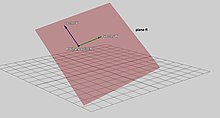
Vector clarification of a plane
where s and t range over all real numbers, v and due west are given linearly contained vectors defining the airplane, and r 0 is the vector representing the position of an capricious (only fixed) point on the plane. The vectors v and westward can be visualized as vectors starting at r 0 and pointing in different directions along the aeroplane. The vectors v and w tin can exist perpendicular, only cannot be parallel.
Describing a plane through three points [edit]
Let p 1=(x 1, y 1, z 1), p 2=(x two, y two, z 2), and p 3=(ten 3, y 3, z three) be non-collinear points.
Method one [edit]
The plane passing through p 1 , p ii , and p three can be described as the set of all points (x,y,z) that satisfy the following determinant equations:

Method two [edit]
To depict the aeroplane by an equation of the form , solve the following organization of equations:




This system can be solved using Cramer'southward rule and bones matrix manipulations. Let
- .
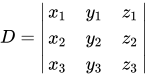
If D is non-zip (so for planes not through the origin) the values for a, b and c can be calculated as follows:
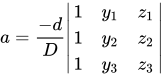
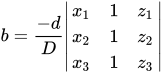
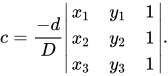
These equations are parametric in d. Setting d equal to whatever non-zero number and substituting it into these equations will yield ane solution set.
Method 3 [edit]
This aeroplane tin likewise be described past the "bespeak and a normal vector" prescription above. A suitable normal vector is given past the cross product

and the point r 0 tin can be taken to be whatever of the given points p 1 , p 2 or p iii [viii] (or whatever other betoken in the airplane).
Operations [edit]
Distance from a point to a plane [edit]
For a plane and a indicate non necessarily lying on the plane, the shortest distance from to the plane is



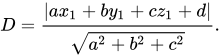
It follows that lies in the aeroplane if and merely if D=0.
If meaning that a, b, and c are normalized[9] and so the equation becomes


Another vector grade for the equation of a aeroplane, known as the Hesse normal course relies on the parameter D. This class is:[seven]

where is a unit normal vector to the aeroplane, a position vector of a point of the plane and D 0 the distance of the plane from the origin.


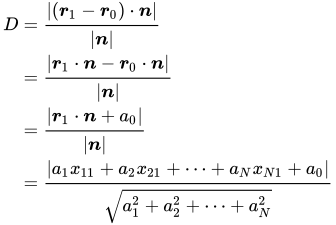
The general formula for higher dimensions can be quickly arrived at using vector note. Allow the hyperplane have equation , where the is a normal vector and is a position vector to a point in the hyperplane. We want the perpendicular distance to the point . The hyperplane may likewise be represented by the scalar equation , for constants . Likewise, a corresponding may exist represented as . We desire the scalar projection of the vector in the direction of . Noting that (as satisfies the equation of the hyperplane) nosotros have



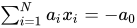





- .
Line–plane intersection [edit]
In analytic geometry, the intersection of a line and a aeroplane in iii-dimensional space tin can be the empty set, a bespeak, or a line.
Line of intersection betwixt two planes [edit]
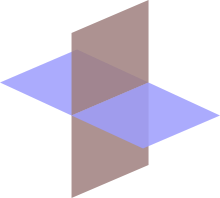
2 intersecting planes in iii-dimensional space
The line of intersection between two planes and where are normalized is given by




where
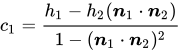
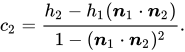
This is found by noticing that the line must be perpendicular to both plane normals, and so parallel to their cantankerous product (this cross production is zero if and only if the planes are parallel, and are therefore non-intersecting or entirely coincident).

The remainder of the expression is arrived at past finding an arbitrary bespeak on the line. To do then, consider that any indicate in space may be written every bit , since is a basis. We wish to detect a signal which is on both planes (i.e. on their intersection), so insert this equation into each of the equations of the planes to go two simultaneous equations which can be solved for and .




If nosotros further assume that and are orthonormal then the closest point on the line of intersection to the origin is . If that is not the case, then a more than complex procedure must be used.[x]



Dihedral angle [edit]
Given two intersecting planes described by and , the dihedral angle between them is defined to be the angle betwixt their normal directions:




Planes in various areas of mathematics [edit]
In add-on to its familiar geometric structure, with isomorphisms that are isometries with respect to the usual inner product, the plane may be viewed at various other levels of brainchild. Each level of abstraction corresponds to a specific category.
At one extreme, all geometrical and metric concepts may be dropped to leave the topological plane, which may be thought of equally an idealized homotopically trivial infinite rubber canvas, which retains a notion of proximity, but has no distances. The topological plane has a concept of a linear path, but no concept of a straight line. The topological plane, or its equivalent the open up disc, is the basic topological neighborhood used to construct surfaces (or 2-manifolds) classified in depression-dimensional topology. Isomorphisms of the topological plane are all continuous bijections. The topological plane is the natural context for the branch of graph theory that deals with planar graphs, and results such as the four color theorem.
The plane may as well be viewed as an affine infinite, whose isomorphisms are combinations of translations and not-singular linear maps. From this viewpoint in that location are no distances, but collinearity and ratios of distances on any line are preserved.
Differential geometry views a airplane as a 2-dimensional existent manifold, a topological plane which is provided with a differential structure. Again in this case, there is no notion of distance, but there is now a concept of smoothness of maps, for example a differentiable or shine path (depending on the type of differential construction applied). The isomorphisms in this instance are bijections with the chosen caste of differentiability.
In the contrary direction of abstraction, we may apply a uniform field structure to the geometric aeroplane, giving rise to the complex airplane and the major expanse of complex analysis. The complex field has just 2 isomorphisms that get out the real line fixed, the identity and conjugation.
In the same way as in the real case, the aeroplane may likewise be viewed as the simplest, one-dimensional (over the complex numbers) complex manifold, sometimes called the circuitous line. However, this viewpoint contrasts sharply with the instance of the aeroplane as a 2-dimensional real manifold. The isomorphisms are all conformal bijections of the complex airplane, but the simply possibilities are maps that represent to the composition of a multiplication by a complex number and a translation.
In add-on, the Euclidean geometry (which has zero curvature everywhere) is not the but geometry that the aeroplane may take. The plane may be given a spherical geometry by using the stereographic project. This tin be thought of as placing a sphere on the aeroplane (only like a ball on the floor), removing the top point, and projecting the sphere onto the plane from this point). This is one of the projections that may be used in making a flat map of part of the Earth's surface. The resulting geometry has constant positive curvature.
Alternatively, the plane can also be given a metric which gives information technology constant negative curvature giving the hyperbolic plane. The latter possibility finds an awarding in the theory of special relativity in the simplified case where in that location are two spatial dimensions and ane time dimension. (The hyperbolic plane is a timelike hypersurface in three-dimensional Minkowski space.)
Topological and differential geometric notions [edit]
The one-bespeak compactification of the plane is homeomorphic to a sphere (see stereographic projection); the open up disk is homeomorphic to a sphere with the "n pole" missing; calculation that point completes the (meaty) sphere. The result of this compactification is a manifold referred to as the Riemann sphere or the complex projective line. The projection from the Euclidean plane to a sphere without a point is a diffeomorphism and even a conformal map.
The plane itself is homeomorphic (and diffeomorphic) to an open up deejay. For the hyperbolic plane such diffeomorphism is conformal, but for the Euclidean plane information technology is not.
Run into also [edit]
- Face (geometry)
- Apartment (geometry)
- Half-plane
- Hyperplane
- Line–plane intersection
- Aeroplane coordinates
- Plane of incidence
- Plane of rotation
- Point on plane closest to origin
- Polygon
- Projective plane
Notes [edit]
- ^ In Euclidean geometry it extends infinitely, just in, e.g., Elliptic geometry, it wraps around.
- ^ Euclid's Elements likewise covered solid geometry.
- ^ Eves 1963, p. 19
- ^ Joyce, D.Eastward. (1996), Euclid'southward Elements, Book I, Definition seven, Clark University, retrieved 8 August 2009
- ^ Anton 1994, p. 155
- ^ Anton 1994, p. 156
- ^ a b Weisstein, Eric W. (2009), "Plane", MathWorld--A Wolfram Web Resources , retrieved 8 August 2009
- ^ Dawkins, Paul, "Equations of Planes", Calculus 3
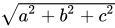
- ^ To normalize arbitrary coefficients, divide each of a, b, c and d by (which can not be 0). The "new" coefficients are now normalized and the post-obit formula is valid for the "new" coefficients.
- ^ Airplane-Plane Intersection - from Wolfram MathWorld. Mathworld.wolfram.com. Retrieved 2013-08-xx.
References [edit]
- Anton, Howard (1994), Elementary Linear Algebra (7th ed.), John Wiley & Sons, ISBN0-471-58742-7
- Eves, Howard (1963), A Survey of Geometry, vol. I, Boston: Allyn and Salary, Inc.
External links [edit]
- "Plane", Encyclopedia of Mathematics, Ems Printing, 2001 [1994]
- Weisstein, Eric W. "Plane". MathWorld.
- "Easing the Difficulty of Arithmetic and Planar Geometry" is an Arabic manuscript, from the 15th century, that serves as a tutorial most plane geometry and arithmetic.
Source: https://en.wikipedia.org/wiki/Plane_%28geometry%29
0 Response to "Do You Need to Know Algebra to Take Plane Geometry"
Post a Comment